


Your shopping cart is empty!
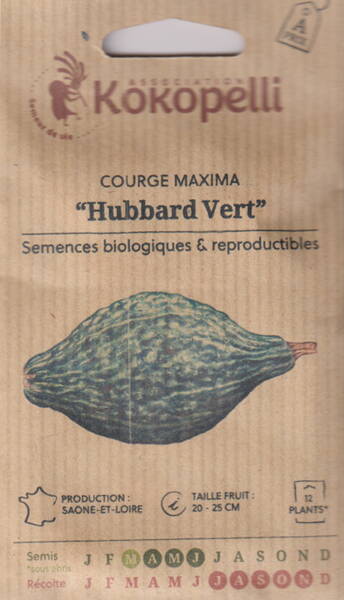
Pumpkin “Hubbard Vert” (Green Hubbard)
Eco seeds
New
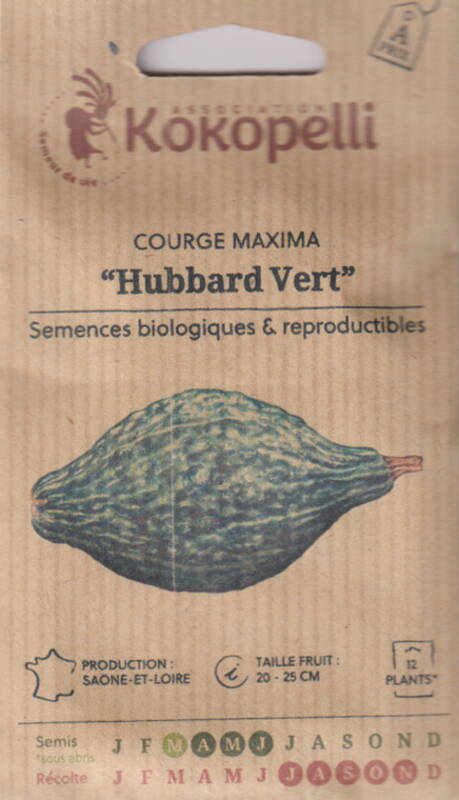
Pumpkin “Hubbard Vert” (Green Hubbard) — Cucurbita maxima Duchesne.
This miracle pumpkin can be eaten fresh like sweet fruit!
An exceptionally tasty and very old heirloom variety, producing numerous spindle-shaped fruits that can reach 25 cm in length and weigh up to 10 kg. Their striped green skin conceals dense, dry orange flesh with a sweet flavor. The fruits boast outstanding storability and can be kept for nearly a whole year. They have an exceptionally high carotene content (25.5 mg%). Sugar content is 4.25%.
The plant is vigorous with long vines. Versatile in use: perfect for fresh salads, baking, and processing into juice.
This miracle pumpkin can be eaten fresh like sweet fruit!
An exceptionally tasty and very old heirloom variety, producing numerous spindle-shaped fruits that can reach 25 cm in length and weigh up to 10 kg. Their striped green skin conceals dense, dry orange flesh with a sweet flavor. The fruits boast outstanding storability and can be kept for nearly a whole year. They have an exceptionally high carotene content (25.5 mg%). Sugar content is 4.25%.
The plant is vigorous with long vines. Versatile in use: perfect for fresh salads, baking, and processing into juice.
Technical characteristics:
-
Maturity: late-maturing variety (120 days from germination to maturity).
-
Fruit weight: 6000 — 10000 g.
-
Flower feature: edible.
-
Vine length: 150 — 400 cm.
-
Fruit size: 20 — 25 cm.
History and origin: “The Legendary Heritage of New England”.
According to Gregory's family chronicles, this venerable variety was brought from Boston to Marblehead around 1798. Its roots are believed to trace back to the Caribbean or South America. It gained wide fame thanks to James Gregory of Marblehead (Massachusetts), who introduced it to the public around 1845. The variety is rightfully considered a classic of world vegetable growing and is mentioned in the famous 1883 catalog by Vilmorin-Andrieux, “Les Plantes Potagères”.
* Pumpkins are grown both by direct sowing in open ground and through seedlings.
Before sowing, seeds are warmed at +60°C for 2—3 hours or soaked for a day in a stimulating solution (e.g., Epin, 2—7 drops per 100 ml of water). After soaking, the seeds are sown immediately or pre-germinated.
Long-vining varieties are best grown through seedlings in pots 10—15 cm in diameter filled with a light nutrient mixture.
Soil preparation:
In autumn, it is loosened shallowly, and after 2—3 weeks it is dug to a depth of 25—30 cm with the application of organic (5—10 kg/m²) and mineral fertilizers (NPK, 30—40 g/m²).
In spring, the dug area is loosened with a rake. A secondary digging is carried out on the day of sowing or the day before. On heavy and wet soils, raised beds are made.
If organic fertilizers are lacking, they can be added directly to the planting holes (1—2 kg each). It is also advisable to add 10 g of superphosphate and potassium sulfate.
Pumpkins are sown when the air temperature reaches +15—18°C, and the soil at a depth of 10—12 cm warms up to +10—12°C (typically late May). Long-vining varieties are placed in a single row in the middle of the bed. The distance between holes in a row should be 0.75—2 m.
Bush forms are planted according to the schemes: 1.2×1.2 m; 70×70 cm. Two seeds of giant pumpkins are placed in each hole.
After sowing, the holes are mulched with humus mixed half-and-half with soil.
Seedlings are planted when the threat of frost has passed. Holes are watered with warm water, 1—2 liters each.
Pumpkin seedlings are planted deeper than they grew in the pot, covering the stem with earth up to the cotyledon leaves. In case of returning cold, cover the plants with horticultural fleece.
Seedlings are watered daily with warm water and the soil is loosened. When 1—2 true leaves appear, the plants are thinned out, leaving one plant per hole for giant pumpkins.
The first top dressing is carried out after 2—3 weeks. A good effect is given by a combined top dressing: 1.5 kg of thick liquid cow manure and 2 tablespoons of NPK fertilizer per 10 liters of water.
Pumpkins are watered heavily but rarely in the first half of the growing season to soak the soil to root depth (20—30 cm).
Some gardeners pinch the main vine to speed up fruit setting.
The main yield of pumpkins is formed on the main stem. The formation of side shoots after pinching does not accelerate, but on the contrary, lengthens the fruit ripening period, so their number is limited to 2—3. Non-bearing shoots are removed entirely.
On long-vining varieties, only after the formation of 2—5 ovaries 17 cm in diameter can all growing points be pinched, leaving 5—7 leaves above each fruit. Usually, this happens after August 10. Further pruning of new female flowers and shoot tips accelerates fruit ripening.
For larger fruits, leave 1—2 fruits on long-vining plants, pinching the stem 3 leaves past the last fruit.
Harvesting begins after the first frost. The pumpkins are dried and placed in a dry, warm shed for 2 weeks to cure. Before hard frosts, transfer them to a room with a temperature above +5°C.